Purpose: The purpose of this segment will be to gather and accumulate everyone's summer adventures and stories. It will primarily focus on what everyone did in the summer..only interested stuff allowed!
Information: To gather the information for this piece we will interview those who want to get there summer story out to our student body. We will try to gather a variety of students from freshman to the glorious seniors. Approximately two-three students per class so my partner and I could evaluate who has the most interesting stuff to say. Maybe more seniors interviewed because it was our last summer of high school.
Interview Questions: What did you do this past summer? Who did you spend your summer with? What are you looking forward to in the next summer? Do you wish you did something else this past summer? Are you happy with how your summer went? What was your favorite moment of summer?
Shot Selection: Mainly composed of close ups and waist shots depended on the interviewee. For B roll throw in a mix of YouTube videos of what people did or some long shots of a beach if that's what some people did or action shots of a sport someone might have participated in the summer.
General Flow: Begin with a summer title sequence then possibly a voice over that says lets look into what the cap students were up to this past summer. Then a quick pan to first interviewee to begin interviews and have the interviewers go one at a time switching from person to person after each question. As the interviewee is speaking play B roll of their past summer after every five to ten seconds of the interviewee speaking, so there is some variation of the scenery. Lastly a voice over that says well cap we have heard some interesting and memorable things this past summer, hopefully next summer will be as exciting.
Scripts: A voice over in the start of the segment asking how this past summer went. Then the above interview questions; to make the interviews flow have all the interviewees alternate after each answer, so the same question is only asked once and everyone answers them sequentially. At the end a grand finish voice over that sums everything up saying how great the summer went and express looking forward to next years summer.
Intro: Well cap school has begun lets take a look at how students spent this past summer!
Closing: Wow we have heard some pretty exciting stuff this past summer its a shame it had to end so quick! Hopefully next year's summer is as interesting as this past one!
Wednesday, August 17, 2011

Monday, April 11, 2011
Production Portfolio-The Retreat
Rationale:
Our film The Retreat where a boy, Benjamin loses his father in a car accident, learns to cope with his loss through the help of a friend. The plan consisted of a straight-forward script that would make shooting what we envisioned run smoothly. We felt this film was set up for great detail on sounds and had various angles to it that would interest its viewers. We avoided styles that were over played and created a plot that was dramatic, but intriguing. This film pertains to people who have faced struggles but has had people, there for them to aid during tragedies that seem impossible to bounce back from.
Word Count: 109
Commentary:
 My main role in this film would be editor, the one who cut the film and put it into the narrative that we envisioned originally. Throughout this film I had an active role in its production though also because I also was the lead actor, so was needed for almost every shot and day of shooting. In the the pre-production we used an original idea from one of our production partners but adapted it and changed it significantly, so it had various angles instead of one dimension. We didn't want one type of genre, but tried to fuse some together to create a movie that stands out and is different from what you'd normally expect. The script we came up with ultimately incorporated many angles that fit what we wanted and we collaboratively approved of it. Acting was time consuming and took time from editing the film at intervals and I ended up editing everything in one long night.
 Problems that arose in my area first of in acting was having all of us on the set at the same time that fit everyone's schedules. We each had our own responsibilities and commitments, so had some time issues, but for me whenever I was needed since it was my production as well as my groups, I tried to free up whenever I was needed. It was also frustrating because we had to do certain scenes over and over again because we had audio mishaps due mainly to using unfamilar equipment that we had no previous experience with. A specific scene that we had to retake was the car shots outside of my house because of audio issues.
Also pre-production set backs put our group already behind in scedule because we couldn't create a treatment that fit what everyone envisioned. After many failed treatments we decided to collaborate on one and incorporate various angles that interested our own views and put it together to make a script that seemed more than suitable.
 The other main problem I encountered was editing because we were using mainly all HD footage the comuter I originally planned on editing on had an insufficient amount of memory and was too slow to edit properly on. So we had to borrow a seniors computer but throughout class, her computer was constantly needed and evidently I had limited time to edit the movie in class. Also we were unable to export the EDL for the project, so instead of editing where I had left off I basically had to start from scratch. We also didn't have all the footage until late spring break, so my editing time also took a cut due to all the focus on shooting.
 First off we solved most acting issues by asking ahead of time to ensure that our actors would be free on shooting days. Also we only casted those who would be easiest to use and who is trustworthy in trying to make our film as well made as possible. For the frustration aspects we still realized were learning and the retakes allowed us to perfect the shots we wanted and not miss any details we wanted to incorporate.
The pre-production mishaps proved to be enlightening and allowed our idea to further develop, which was the result of a well-written, in depth script that incorporated angles that everyone on our production team approved of.
 Editing was a hassle but I ended up using one of my production team mates computer to edit all of the film since we couldn't download the files I already had edited. Time wise I spent most of one night to edit since our script was straight forward and we had a ingenious plot the narrative flowed well together. The color correction I felt we added in the film enhanced our editing of the film and created a more cinematic look.
 A critical problem overall for our film was sound design because we each had our own distinct role we didn't have a key component of our production a sound designer. Also we didn't have access to the music files at class or the programs to make our own sounds so needed to find scratch files throughout the internet. We knew sound was a key component of making our movie as flawless as possible, but sound throughout the film was a problem because twice we didn't have audio in the shots we thought we did. Also some shots were a bit shaky but that was merely due to shots being taking by hand. Lastly another problem overall was understanding what emotion the director wanted at the specific time and if the emotion wasn't understandable how to create what he wanted.
 These problems were fixed almost completely throughout the production of our final product. First off our director took the role of the sound designer since he was familiar with music and had the computer where our project was on, he played a major role in incorporating the sounds we wanted and setting the overall mood of the film. With the shots we didn't have audio we scratched them and took many retakes and ensured their was audio so we wouldn't have to continue to do retakes. One shot we particularly liked we dubbed, which sounded pretty realistic and almost surprisingly perfect. The shaky shots our cinematographer realizes that they look a bit unprofessional but, its also still early stages of learning what shots work and how to make each shot as stead and professional as possible. Understanding what the director was asking was fixed by him actually showing what he wanted or describing what he wanted, so we could portray what was being asked as well as possible.

 I felt our final product came out as well as I pictured it to be but still some shots we used like the night shots turned out to be extremely grainy making the film have a less professional feel to it. Instead of any night shots we should and will plan on shooting in daylight because the grain look took away from the message of the shots in the end and trying to mingle with the color correction did little to help those shots. Also the dubbing near the beginning is almost spot on, but dubbing things takes away from the film because it doesn't have the actual professional feel. Acting has to be key for our next film since some emotions couldn't be understood or portrayed as effectively as desired. Also each shot needs to have a purpose to it and the car driving shots seemed to drag a bit and didn't seem like it was progressing the plot very much. Lastly to make our film as professional I think adding color and different color correctors to each scene slightly would enhance the overall meaning of our final product to make it as realistic and cinematic as possible.
Word Count:1128
Our film The Retreat where a boy, Benjamin loses his father in a car accident, learns to cope with his loss through the help of a friend. The plan consisted of a straight-forward script that would make shooting what we envisioned run smoothly. We felt this film was set up for great detail on sounds and had various angles to it that would interest its viewers. We avoided styles that were over played and created a plot that was dramatic, but intriguing. This film pertains to people who have faced struggles but has had people, there for them to aid during tragedies that seem impossible to bounce back from.
Word Count: 109
Commentary:
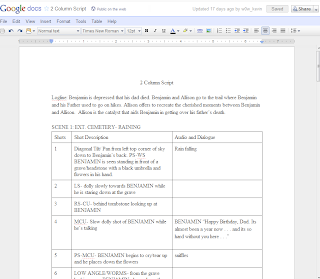 My main role in this film would be editor, the one who cut the film and put it into the narrative that we envisioned originally. Throughout this film I had an active role in its production though also because I also was the lead actor, so was needed for almost every shot and day of shooting. In the the pre-production we used an original idea from one of our production partners but adapted it and changed it significantly, so it had various angles instead of one dimension. We didn't want one type of genre, but tried to fuse some together to create a movie that stands out and is different from what you'd normally expect. The script we came up with ultimately incorporated many angles that fit what we wanted and we collaboratively approved of it. Acting was time consuming and took time from editing the film at intervals and I ended up editing everything in one long night.
 Problems that arose in my area first of in acting was having all of us on the set at the same time that fit everyone's schedules. We each had our own responsibilities and commitments, so had some time issues, but for me whenever I was needed since it was my production as well as my groups, I tried to free up whenever I was needed. It was also frustrating because we had to do certain scenes over and over again because we had audio mishaps due mainly to using unfamilar equipment that we had no previous experience with. A specific scene that we had to retake was the car shots outside of my house because of audio issues.
Also pre-production set backs put our group already behind in scedule because we couldn't create a treatment that fit what everyone envisioned. After many failed treatments we decided to collaborate on one and incorporate various angles that interested our own views and put it together to make a script that seemed more than suitable.
 The other main problem I encountered was editing because we were using mainly all HD footage the comuter I originally planned on editing on had an insufficient amount of memory and was too slow to edit properly on. So we had to borrow a seniors computer but throughout class, her computer was constantly needed and evidently I had limited time to edit the movie in class. Also we were unable to export the EDL for the project, so instead of editing where I had left off I basically had to start from scratch. We also didn't have all the footage until late spring break, so my editing time also took a cut due to all the focus on shooting.

The pre-production mishaps proved to be enlightening and allowed our idea to further develop, which was the result of a well-written, in depth script that incorporated angles that everyone on our production team approved of.
 Editing was a hassle but I ended up using one of my production team mates computer to edit all of the film since we couldn't download the files I already had edited. Time wise I spent most of one night to edit since our script was straight forward and we had a ingenious plot the narrative flowed well together. The color correction I felt we added in the film enhanced our editing of the film and created a more cinematic look.
 A critical problem overall for our film was sound design because we each had our own distinct role we didn't have a key component of our production a sound designer. Also we didn't have access to the music files at class or the programs to make our own sounds so needed to find scratch files throughout the internet. We knew sound was a key component of making our movie as flawless as possible, but sound throughout the film was a problem because twice we didn't have audio in the shots we thought we did. Also some shots were a bit shaky but that was merely due to shots being taking by hand. Lastly another problem overall was understanding what emotion the director wanted at the specific time and if the emotion wasn't understandable how to create what he wanted.
 These problems were fixed almost completely throughout the production of our final product. First off our director took the role of the sound designer since he was familiar with music and had the computer where our project was on, he played a major role in incorporating the sounds we wanted and setting the overall mood of the film. With the shots we didn't have audio we scratched them and took many retakes and ensured their was audio so we wouldn't have to continue to do retakes. One shot we particularly liked we dubbed, which sounded pretty realistic and almost surprisingly perfect. The shaky shots our cinematographer realizes that they look a bit unprofessional but, its also still early stages of learning what shots work and how to make each shot as stead and professional as possible. Understanding what the director was asking was fixed by him actually showing what he wanted or describing what he wanted, so we could portray what was being asked as well as possible.

 I felt our final product came out as well as I pictured it to be but still some shots we used like the night shots turned out to be extremely grainy making the film have a less professional feel to it. Instead of any night shots we should and will plan on shooting in daylight because the grain look took away from the message of the shots in the end and trying to mingle with the color correction did little to help those shots. Also the dubbing near the beginning is almost spot on, but dubbing things takes away from the film because it doesn't have the actual professional feel. Acting has to be key for our next film since some emotions couldn't be understood or portrayed as effectively as desired. Also each shot needs to have a purpose to it and the car driving shots seemed to drag a bit and didn't seem like it was progressing the plot very much. Lastly to make our film as professional I think adding color and different color correctors to each scene slightly would enhance the overall meaning of our final product to make it as realistic and cinematic as possible.
Word Count:1128
Tuesday, March 8, 2011
Oral Presentation Critique
The film I reviewed and analyzed was Gran Torino. I covered various topics in accessing this film and started off with some background information about the widely known Clint Eastwood. Clint Eastwood used various techniques to create a movie based on the socio-cultural context of an issue that still resides today. The movie was heavily based on racism and racist comments were sprinkled throughout the film. Other aspects of the film included religious, a struggle for identity and harshness eases as one character realizes the constant hardships of an abused race. Clint Eastwood resolves the story and the gang issue by sacrificing himself in a religious relation to God. I thought my breakdown of the cinematography of my scene was well thought out and discussed but I became repetitive as the techniques seemed to overlap. The repeating become natural because the scene had a lot of similar ideas in it, but it seemed to drag on a bit too much and originally I didn't have enough speaking time because I thought I had too much information. Overall I think this performance is worthy of a 19 because it didn't stray too far and had minor miscues.
Tuesday, February 8, 2011
Oral Presentation- Part 3 Narrative and Scene Analysis
 The film is constructed in a manner which show's racist views and a struggle between character's accepting and acknowledging their surrounding environment. Clint Eastwood constructs the story in which character's develop and racist views are neglected and forgotten as character's relationships grow. The movie is organized by the plot which allows the story to go on. The plot goes from hatred for a race and a neighborhood to a more compassionate care for the main character who learns to accept his surroundings. With the attempt of stealing Eastwood's prized Gran Torino to the gang's constant antagonizing the story moves along significantly as the plot accelerates and goes on too. The nature of the engagement with the characters is that each character creates a new conflict with one another and allows a relationship to grow whether good or bad.
 The characters and issues are represented in a straightforward manner in which each issue is resolved either right away, like the attempted stealing of Eastwood's Gran Torino or resolved gradually like the gang issue. The characters become more dynamic or the protagonists, while the antagonists the gang is more stagnant. The shot angles and camera movement allow each scene to build an anticipation or show emotion that isn't as easily portrayed through just seeing the character. In the end when Eastwood dies his body is laying in a crucifix position imitating something biblical and giving a religious death to the denouement of the film. Meaning is created well through sequence because it allows each event to move the plot forward and build to the rising action. The sequence of each event allows anticipation and tension to build even further so the viewers are on the edge of their seat. Lighting plays a key role in the movie because the darker shades and lighting allows the viewer to anticipate something bad occurring or a critical moment to further move the plot further. In this movie sound plays more of a key role than music because each sound allows us to create a new characterization of the character's, while the music is more for a mere transitioning between sequences. The location analysis argue as well as I, has no key meaning to it, Michigan I think was more for scenery rather than particular meaning to it. I think a key vital symbol of the movie is the Gran Torino, which symbolizes justice and the overcoming of racial prejudice. Clint Eastwood a man prejudice and racist to characters especially Asian ones because he fought in the war against them, ends up growing to accept his neighbors and giving his prized car to Thao. The emotional message created through the film-making is that doing the right thing sometimes is even more precious than life itself and allows readers to see the process of development through Clint Eastwood.
Tuesday, February 1, 2011
Oral Presentation Part 2- Historical and Socio - Cultural
Gran Torino was directed by Clint Eastwood, who also played the leading acting role in this movie. Clint Eastwood started as an actor in the old studio system, when the major movie companies were still in the business of American life rather than international properties. Clint Eastwood incorporates some old acting styles and characterisitcs of late movies into his character as Walt Kowalski in Gran Torino. This story was written by a new film writer Nick Schenk who decieded to express Hmong hardships and racsim, which was believed to be neglected. The film's production company was Warner Brothers which helped the film win 13 awards and 7 nominations one of the more notable wins inculded a golden globe nomination for the best original song-motion picture.
The films historical context is primarily its setting in Michigan, also to reveal a neglected group of our society the Hmong people. The film reveals a racist old man played as Clint Eastwood who is a Korean War Veteren despising Asians being a critical racist. Throughout the movie Clint Eastwood becomes a positive image and a savior to the Hmong people and the neighbors living by. Eastwood grows fond of the Hmong neighbors and devotes his life to ceasing the gang violence in his neighborhood. Historically it reveals racist views on Asians primarily Hmong people who are neglected in society.
The socio-cultural relation of this film is that it was made for a wide range of audiences that endure the racism and racist views of people towards Asians. The racism revealed proved to be a key factor in Eastwood's character who despised the sight of Asians even approaching his property. The film also reveals the harshness Hmong people are enduring in our country and the antogonizing for being Asian- American. Not all racist films need to portray Latin Americans or Blacks this film calls to Asian racism which is passed upon. I believe Eastwod tried to potray a growth in ones character and reveal that acceptance even for harsh racists like his character takes time to develop.
Friday, January 28, 2011
Sound Treatment
Logline:
This will take place at crystal springs trail on a bench overlooking the spring. Near sunset, since sun sets over the spring three couples have a same sanctuary.
Boy walking (head down) sits down on park bench. He sighs as he sits down. He puts his face in his hands in distress as a young couple walks by behind him. They look to be as though they are in love and are talking to teach other and as they pass the bench the boy looks at their backs as they walk away and their audio fades out. The boy sighs again and then takes out his headphones and we can hear the music from his i pod.
Then middle age couple walks by in the background from right side. The boy doesn’t notice, but they talk about how they always love coming back to this trail and how peaceful it is.
Boy is looking out at the spring as they are walking by and they exit off screen
Then old couple walks by from left side and they sit down next to the boy on the bench. Boy takes off his headphones and says sure you can sit here.
Old couple are talking and they are audible and they are talking about how much they enjoy each other, boy puts his head back down in his hands still in distress.
Old people respond. Old man tells him some words of wisdom about relationships (not too cliche) maybe some humor about himself and his wife.
Old lady says time for us to go, so they both get up, old man tells boy it will be “alright kid pull through”.
After they leave out of the WS. All isolated sounds. Boy relaxes back in his park bench and looks at the spring again (hears small sound of waves). Boy looks at Grass and hears the sound of crickets, and soft wind sound as wind is blowing nearby grass. (if there's no wind it will have to be man made and sound effect can be put in later). Boy looks at free way in back of him and notices sound of cars passing by. Boy looks out at the spring once again and now all sounds are audible. Boy pulls phone out of his pocket with right hand. Looks at it (seems like he is contemplating something) then puts phone down, face down, on his right leg and slouches further back in bench. ONLY THING AUDIBLE Phone starts ringing (ring tone differences genuine or some r&b song). Boy turns his phone back over and looks at the front and caller ID says Katy and picture is of boy and Katy smiling (happy). Boy looks at it then looks out at spring and left to right (now all previous sounds in green are heard) then he looks back at phone (only ring tone is heard) boy contemplates and then pushes silent on his phone. (WS from beginning) Gets up and walks out of frame. Time lapse until night time then fade out.
Narrative:
The narrative design is a romantic. My goal of this film was to be serious throughout the whole film. I have gone on this trail many times before, and I always notice how nice and serene the view is, although the freeway is right behind it. I based most of the story off of the scene and what i could get of it. I want to experiment with isolated sounds, and then joining all the sounds together to create a soothing nature effect.
Production elements:
I wanted to incorporate nature with sound. I want to use sound bridges maybe to connect different transitions. I planned on using the music the boy was listening too and his ring tone to play as the leitmotif, and I was also thinking about incorporating some sound loops or even create my own.
Shot selection vary to establish the scenery and take the sounds of nature while minimal sound to the actual characters.
Monday, January 24, 2011
Director's Influence
Gran Torino is a 2008 American drama film directed, produced and starring Clint Eastwood, who produced many notable movies.The other features determining the drama of the film are that the main character Walt Kowalski played by Clint Eastwood is a Korean War Vet who has lost his wife and treats his family and neighbors harshly. Kowalski lives by poor Asian immigrants who he dramatically learns to defend. Another film this movie connects to could be the other film he has directed and starred in Million Dollar Baby. Eastwood in both films has a similar character in which he softens and learns to accept those in need of his help. Clint Eastwood directed this film and it was written by Nick Schenk and Dave Johannson. It was written to portray the struggles of Asian Americans who are constantly disregarded, when speaking about struggles in society. Eastwood fights against Asian's in the Korean War, but overcomes his hatred for them opening up and accepting a boy constantly antagonized. We can tell that the movies creators desired to express to its viewers that any man who sees a family in trouble even if he has lost the thing to live for (his wife) has enough heart to help those in need. This fits with Eastwood's other works because the narrative is similar to Million Dollar Baby. In both instances Eastwood opens up to the main characters after being antagonizing to them. I think some shots overlap with the two movies because many waist shots are used effectively with Eastwood and the respective main character in each film confronting each other. I think this film's theme is that racism is overcome by a character who see's hardships that one constantly endures. The target audience is older teens and adults who seek the knowledge of abused Asian immigrants, who encounter constant run-ins with a gang, and in which the antagonist of the film Eastwood transitions to the protagonist.
Subscribe to:
Posts (Atom)